White Paper
MonoMoji Core
A Visual Character Encoding System (and Reader) for Existing Text
v1.0, May 2026
This is deliberately an early-stage document. Its purpose is to convey the system approximately; details and measurements will be added and updated over time.
Current status. MonoMoji is at the prototype / experiment stage. The reader is usable today (you can sign up and try it), but its claimed benefits are not yet proven. No formal user testing has been completed, the current scope is reading-first (writing mode is a later track) and covers English letters and word spaces only, and several open questions remain. Read the numbers and claims below in that light: confirmed design facts and untested hypotheses are kept separate throughout.
1. What MonoMoji is
MonoMoji is an optional, reversible visual character encoding system that sits on top of existing text. It converts selected words into compact symbols, so those parts of the text look different. MonoMoji is not a new language and does not replace the existing one; it encodes letters, not concepts (alphabetic, not logographic).
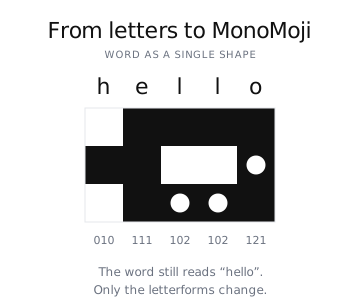
Although MonoMoji encodes letters, the letter-to-pattern assignments are made such that most words appear as a compact, single shape. In normal print, when English letters are set side by side with no gaps between them, they usually combine into large character groups. MonoMoji is designed to test whether frequent word-shapes can become visually familiar in the same way.
MonoMoji in one line. MonoMoji does not change language, grammar, or meaning. It only replaces selected letter strings with visual character patterns. It is alphabet-derived because it is generated from letters, but word-facing because the reader experiences the result as a compact word shape. So although whole words are tuned to read as single shapes, the system is alphabetic (letters), not logographic (concepts).
On the surface it may evoke signs like &, %, $; these too compress frequent units into a single glyph. But it has a critical difference. Those signs are opaque; you have either memorized their meaning or you cannot know it. MonoMoji symbols, by contrast, are decodable at the character level: a reader who has internalized the system can decode even the meaning of a symbol they are seeing for the first time, from its structure. One open possibility is this: past a certain threshold, users may read entire texts in MonoMoji. In the developers' own tests this appeared possible. But how far it can be advanced in practice with intensive, daily training, and whether it can be read more comfortably than normal text, has not yet been measured.
2. Why
Why the old ways are blocked. Writing systems are among the very hard protocols to change. Even a better script is usually not adopted; the problem is not quality but the cost of transition.
MonoMoji passes under this barrier because it does not replace the alphabet but sits on top of it as a personal and reversible layer: the archive is not broken, no one loses anything, and not everyone has to switch at once. Reading additional signs alongside text is not foreign to readers; for example %, $, & are used with letters every day, and Japanese runs hundreds, thousands of kanji together with a syllabic script. MonoMoji builds on this intuition and turns it into an integrated encoding-and-reader system that is decodable at the character level and can be graded personally.
Why now. Reading moved from paper to screen, and with personal devices (phone, tablet, PC) it has become a personalizable experience; this was not possible in the paper era. Yet while personalization could offer advanced readers a more augmented reading experience, in the current system all readers read with the same character-level encoding, as if riding a single-speed bicycle. Moreover, even though we have this possibility, we do not yet seem to have realized that we could use the screen more efficiently; on digital devices we still read with a paper-minded habit, expecting the screen to behave like paper. MonoMoji is a step toward crossing this threshold. Furthermore, while the amount of text we consume through the internet, social media, and AI grows every day, the human reading capacity (time and attention) stays fixed. This widening gap makes an upgrade in how we process text increasingly meaningful; MonoMoji is an experiment in this direction.
The personalization here does not mean that everyone uses their own private code. By default the letter-to-symbol mapping is shared. However, changing it for any reason is possible in advanced settings.
3. Hybrid Reader
The place where MonoMoji is actually experienced is the hybrid reader. MonoMoji and normal text stand together on the same page. This resembles the way Japanese uses its two scripts together: kana is Japanese's simple syllabic (phonetic) script and is learned first; kanji are more complex, meaning-bearing characters and are learned over time. For an elementary student just learning to read, most things are written in kana, and only learned basic words in kanji; as the reading level advances, the number of kanji in the text increases. MonoMoji works by the same logic.
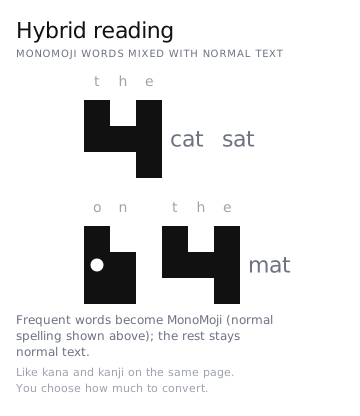
Users start with a few symbols and, as they progress, a larger portion of the text (or all of it) turns into MonoMoji.
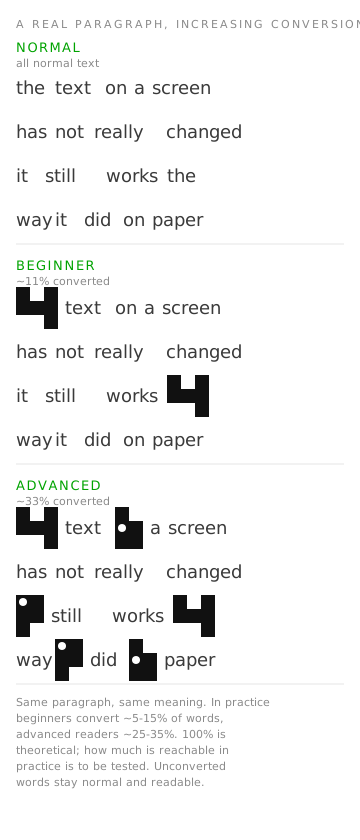
A real paragraph at different conversion levels shows what hybrid text looks like in actual reading: a beginner sees only a few words as MonoMoji, while an advanced reader sees most of them; the unconverted words stay normal text and fully readable. In practice the conversion ratio is roughly 5-15% for beginners and 25-35% for advanced readers. While 100% is theoretically possible, how much is achievable in practice will be seen through experiments.
4. MonoMoji and fonts
MonoMoji can technically be produced as a font file too. However, a font displays all letters in that form; to show only selected words in MonoMoji, a purpose-built browser extension or another application is needed. (With the same extension, any font can also be applied to selected words only, if desired.)
The real difference is readability. A normal font can be read, more or less, by anyone who can read and write (Latin-alphabet fonts can be read by anyone who knows the Latin alphabet). MonoMoji symbols, on the other hand, can be read only by those who have learned the system. So MonoMoji is not a display preference but a learned encoding; it works as a reversible overlay, and when turned off the text returns to its normal form.
5. Encoding architecture
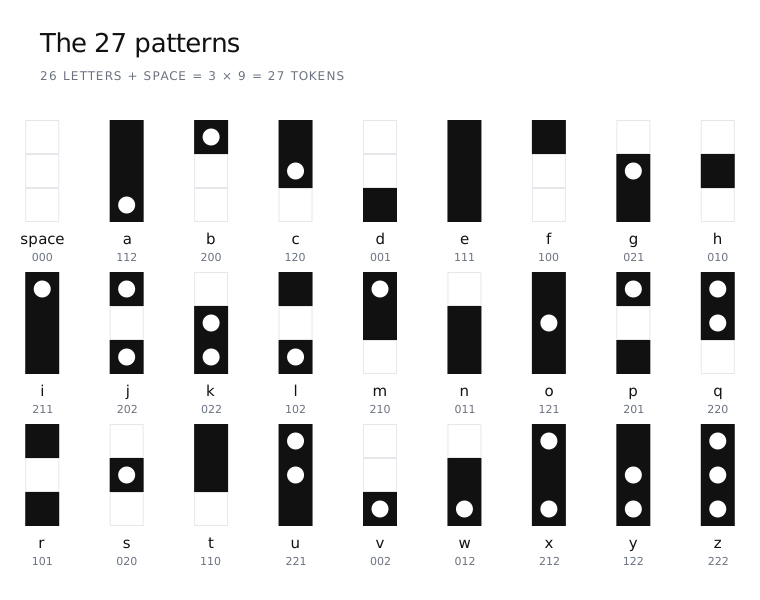
The base unit. Each character is a column of three vertically stacked layers (top, middle, bottom). Each layer takes one of three states: 0 empty (same color as the background, blank), 1 solid (filled block), and 2 dot (a low-prominence dot inside a filled block). Three layers and three states together produce 3 × 3 × 3 = 27 distinct patterns. The 26 letters of the English alphabet plus the inter-word space make exactly 27 tokens, so a one-to-one (bijection) mapping is established between the pattern space and the character set; no pattern is left unused. Each character can thus be expressed as a three-digit three-state code; for example the word “hello” corresponds to the sequence 010 111 102 102 121. The vertical stacking of the layers makes each character a compact, single shape.
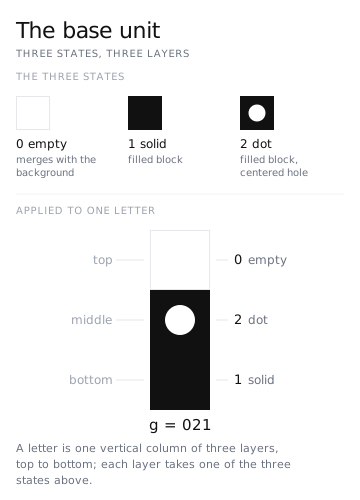
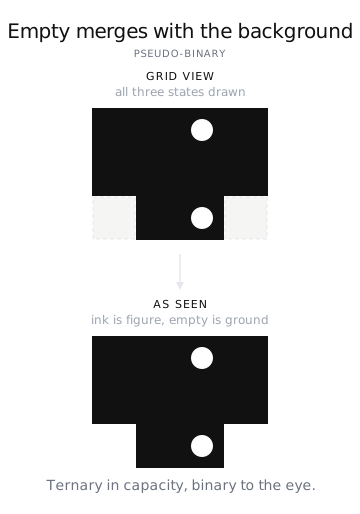
Why it looks almost binary. MonoMoji is a three-state system but at first glance reads as binary. The mechanism is that the empty state merges with the background; the eye perceives the empty block not as a mark but as negative space. Thus the reader sees only the ink (solid and dot) as the figure; the symbol, despite being a three-valued structure, is scanned like a high-contrast, two-valued skeleton. The practical result: information density comes from three states, but the perceptual load stays close to two. Information density (which wants more states) and recognition speed plus low-resolution robustness (which want fewer, high-contrast states) are normally two conflicting constraints; the empty = background approach resolves this conflict by making the third state invisible: capacity three-state, readability binary.
The dot reads like a diacritic (but is not functionally a diacritic). The dot state looks like a mark superimposed on the filled symbol form. This is a familiar visual grammar for an eye that reads Latin diacritics like é, ñ, ü, or the Japanese dakuten/handakuten (ハ → バ → パ): the same base form is distinguished by a small added mark. This resemblance makes MonoMoji intuitive for a brain accustomed to reading diacritics. However, the resemblance is visual and perceptual, not functional: the dot is not an independent, portable operator but the third of a layer's three states. Removing the dot does not simplify the symbol, it produces a different letter.
6. Use cases
The reader is usable today; below is where it applies, labeled by how ready each case is.
- Possible now: a browser layer that converts selected words on web pages into MonoMoji, and a personal symbol library you build up as you read.
- To be tested: MonoMoji as a visual-familiarity or focused-reading aid, an alternative reading mode for different reading styles, and effects on memory and mental capacity.
The first group is what the current product does; the rest are hypotheses to be tested, not promises.
For memory and mental capacity, the theoretical expectation is high: the process of adapting to new symbols may trigger the formation of new synapses, and changing the reading routine may stretch and develop mental capacity. These have not yet been measured.
7. Scope and limits (v1.0)
This version: English letters, the inter-word space, character-level encoding, a reading-first approach, and a single canonical mapping. MonoMoji has no uppercase/lowercase distinction; each letter has a single form. (In Japanese kana and kanji scripts too, a character has no upper/lower case.) No measured reading-speed improvement is being claimed yet; faster reading is among the expectations, but for now this is only a theoretical inference.
There is currently no plan to convert punctuation and numbers into MonoMoji symbols. These are already in symbol form (for example 1 = one, ? = question mark) and already provide enough compression; the value of MonoMoji is in being a plain, simple system that delivers much benefit for little effort. Also, the existing 27 possible patterns are all in use, since they are mapped one-to-one (bijection) to the alphabet; the only way to produce new symbols is to increase the number of states. Since such a fourth state would make the system more complex, it is estimated that ROI and user satisfaction could fall. One possible use of a fourth state is for non-English languages: characters not present in English could be encoded this way.
A theoretical note: the Latin alphabet is not the only writing system to which this symbolic compression could apply; in principle, a MonoMoji-style compression can be applied to any alphabetic writing system. Likewise the system is not limited to English; it could in theory be applied to other languages. However, because the current MonoMoji system's letter-pattern assignments were made for English, equally compact shapes may not be achievable in non-English languages, and this could make MonoMoji perform less well in other languages than in English. Since it would be impractical for a person to learn a separate writing system for each language, this is likely to give English a disproportionate advantage. But this is a subject for a separate discussion, not this white paper.
The writing mode, which falls outside this version, is an especially promising direction and carries the potential to fundamentally change human-machine interaction. To begin, users need to have reached a certain level in reading mode. The current version is reading-assist only, and the current canonical map should not be treated as final for handwriting or stroke-based input; writing mode is a separate, future research track.
8. Status and philosophy
MonoMoji is a bootstrap project and is currently at the experiment stage; we say this openly. It is built on trying the system and the reader at small scale. The voluntary experience and feedback of users interested in the topic will guide the system. The roadmap is phase-gated: reading mode will first be tested and validated, and then writing mode will follow.
Glossary
- Canonical mapping: the default, shared letter-to-pattern assignment; can be changed in advanced settings.
- Reading mode / writing mode: the current reading-assist scope, versus the future track for producing MonoMoji by hand.
Appendices
Inspirations and the development of the idea
What is original here. The original contribution lies not in a single part but in a specific combination: a 27-pattern three-state character set in one-to-one (bijection) correspondence with the alphabet, designed so that words read as integrated shapes, and delivered together with a reader as an optional, reversible overlay. The combination matters because each part removes a barrier the others leave standing: the bijection keeps it learnable, the design makes words cohere as shapes, and the reader-overlay keeps it reversible and adoptable without a clean break from existing text.
MonoMoji's design draws on ideas from different areas, such as fixed-length encodings, multi-layered writing systems, and personalizable reading layers. A detailed comparison of these sources is outside the scope of this document.
Expectations (open questions)
These are not claims but expectations to be tested by the experiment; and this list is not exhaustive, it will be realistically updated with feedback received at later stages.
Near-term validation. The concrete questions an early test can answer:
- Can users comfortably learn the first 10 to 30 symbols?
- Does recognition of converted words improve with exposure?
- Does hybrid text (mixed MonoMoji and normal text) stay readable?
- How much conversion feels comfortable before it becomes effortful?
- Are frequent words that share the same skeleton and differ only by dot position (for example HAS/HIS) discriminable enough at small size, low resolution, or fast reading?
Long-term research. Larger, open-ended questions for later:
- Today's reading is largely symbolic and sequential; could MonoMoji's geometric and spatial forms move reading closer to visual perception?
- How MonoMoji fits different cognitive and perceptual styles, including neurodivergent readers, and different vision conditions, including low-vision users.
Caution. MonoMoji does not currently claim any clinical, therapeutic, or accessibility benefit; any such effect is an open question to be tested in the future.
MonoMoji Core v1.0. For feedback, get in touch.